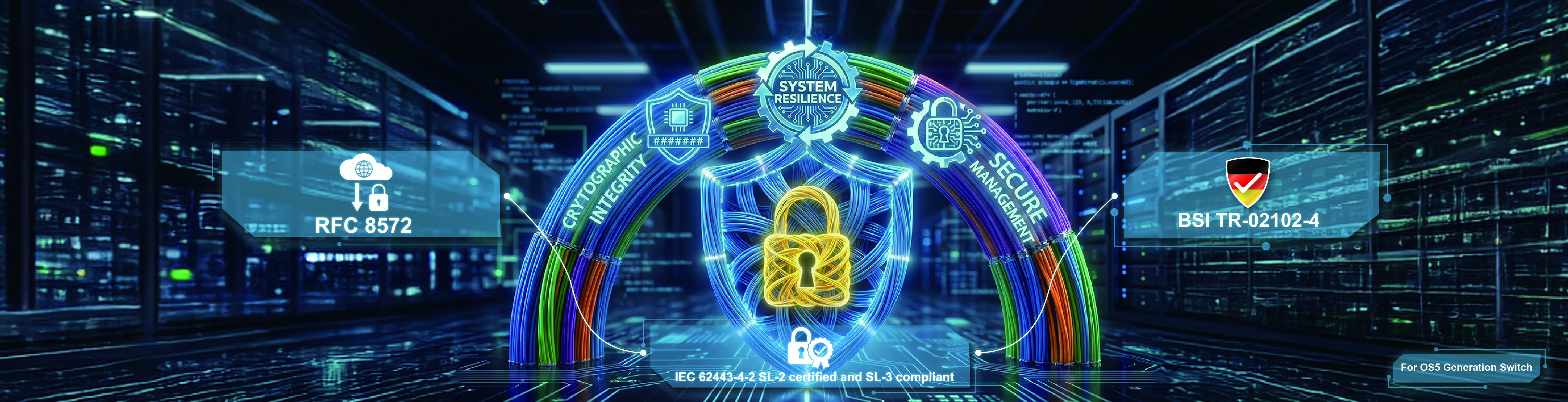
As industrial networks face increasingly sophisticated threats, the Lantech OS5 Security Switch provides a robust, compliant foundation for critical infrastructure, which is designed to meet rigorous cybersecurity standards, including BSI TR-02102-4 and RFC 8572.
To ensure seamless integration and long-term operational stability, OS5 security switch focuses on three critical pillars: Cryptographic Integrity, System Resilience, and Secure Management. The proposed architecture integrates a hardware-based Security IC to handle high-entropy random number generation and key storage, ensuring the device qualifies for deployment in high-threat environments.



Provides Layer 2 data protection by encrypting traffic between the switch and connected devices, helping ensure confidentiality, integrity, and origin authentication for critical network communications.

Weak key exchange methods, ciphers, and MAC algorithms are blocked to maintain strong management security.

The management framework is built on asymmetric cryptography, requiring public key infrastructure for all management access and eliminating shared-secret authentication.

A hardware-based random number generator provides high-quality entropy for cryptographic operations and key generation.

SSH is secured according to BSI TR-02102-4, with weak algorithms such as SHA-1 and 3DES disabled.

Firmware and system updates are verified before loading to ensure only trusted code is executed.

The platform enforces RSA keys of at least 3072 bits and ECDSA keys of at least 256 bits.

Private keys and password hashes are protected inside a dedicated Security IC to resist extraction and tampering.

Helps maintain network availability by detecting and mitigating excessive traffic floods, reducing the risk of service disruption and keeping critical systems operation.

Syslog and Syslog over TLS are supported to protect security event transmission.

Local non-volatile memory provides 100 MB for configuration and 100 MB for logs.

Automatic rotation prevents log loss when storage reaches capacity.

Abnormal CPU or memory usage can trigger a controlled reboot to avoid undefined system behavior.

If an update fails, the device automatically restores the previous stable firmware version.

When a breach is detected, the switch can isolate its network boundary to contain the impact.

This feature enhances memory management by ensuring that each process operates within its own isolated memory space, preventing memory sharing across processes. When a process terminates or the system reboots, its allocated memory is purged to eliminate residual data, thereby strengthening system security and stability.

The system monitors chassis and diagnostic port access and alerts administrators to physical intrusion.

SNMPv3 uses USM, VACM and TSM, with authPriv required for authenticated and encrypted management traffic.
Only SSH version 2 is allowed, while older or proprietary variants are disabled.

Management interfaces such as SSH, CLI, and Web are protected by strict concurrent session controls.

Role-based access control separates read-only and read-write privileges.

Centralized authentication is supported through RADIUS for management access.

NTPv4 supports at least two servers to improve time synchronization reliability and log integrity.

The system can generate automated reports of current security settings for compliance and auditing.
Certified to Security Level 2 requirements for baseline cybersecurity in industrial environments while designed to meet Security Level 3 standards, providing stronger protection against intentional attacks from adversaries with specialized knowledge and moderate resources.

A German cryptographic guideline that defines recommended algorithms, key lengths, and security parameters to support strong, future-proof encryption in sensitive systems. NIST SP 800-131A is the U.S. cryptographic standard, but BSI TR-02102-4 is more stringent. See comparison table below for detailed differences.
An Internet standard that provides guidance for securely using public key infrastructure in network management, helping ensure authenticated and trustworthy device administration.
OS5 Security Switch brings together cryptographic integrity, system resilience, and secure management in one hardened platform for critical industrial networks. With hardware-rooted trust, strong access control, and built-in protection against evolving threats, OS5 helps organizations secure operations with confidence and long-term reliability. Contact us to learn how OS5 can strengthen your network security architecture and support your next critical deployment.